
Background information; by edgardowelelo@yahoo.com
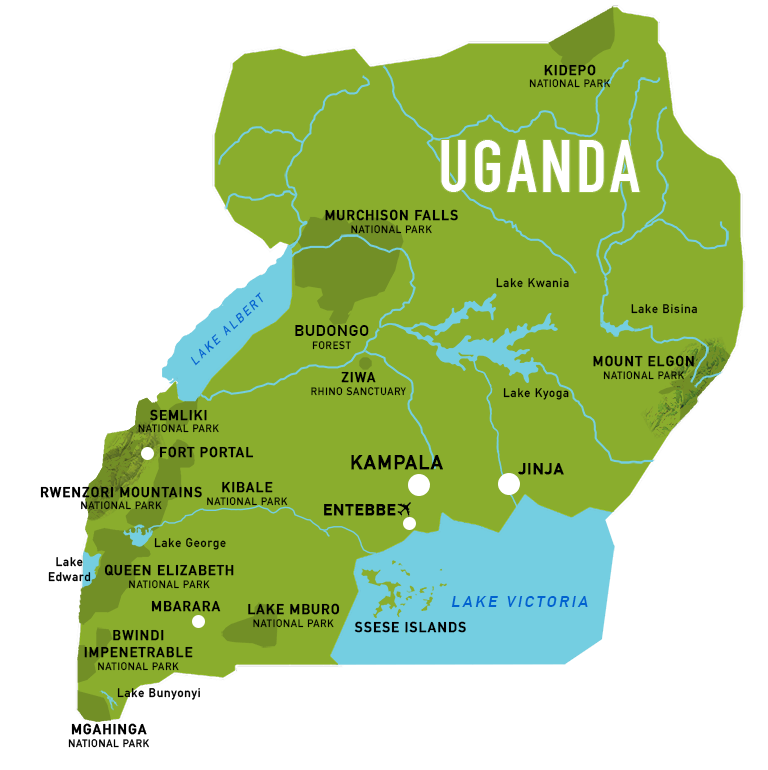 Uganda’s 10 national parks contain a fabulous variety of habitats, ranging from snow – capped Mountain peaks and vast papyrus swamps, to dark tropical forests and open savanna plains. These diverse settings are home to an impressive range of wildlife including 1000 species of birds, with many central African species at the eastern limit of their ranges. Mammals include numerous forest primates, among them chimpanzee and Mountain gorilla, white big game animals are to be found in the Savanna parks
- SEMULIKI NATIONAL PARK (The true Birders’ Haven)
- Park distances from Kampala: 387 KMS
Occupying an isolated slice of Ugandan territory beyond the Rwenzori, the forested Semuliki National Park represents the eastern most tract of the Congo’s Great Ituri Forest. This is an exceptionally exciting destination for bird and primate watchers. The 441 recorded bird species include 216 forest birds and 80 central African species found in few, if any, other forests in East Africa. Black Dwarf Hornbill, Shining Blue Kingfisher, Nkulengu Rail and Yellow – throated Nicator are just a few random highlights cited by the park’s experienced guides. In addition, an astonishing 5 species of primates more even than Kibale can be found within 6 km of the primeval hot springs that bubble out of the rift valley floor at Sempaya.

- SEMULIKI NATIONAL PARK AT A GLANCE
SIZE: 220 km2 with an altitude of 670 – 760 m above sea level.
- Semuliki forest reserve was created in 1952 and upgraded to National park status in 1993.
- It is the only tract of true lowland tropical forest in East Africa hosting 441 recorded bird species and 53 Mammals.
- Four distinct ethnic groups live near the park. Bamba farmers live along the base of the Rwenzori while the Bakonjo cultivate the mountain slopes. Batuku cattle keepers inhabit on the open plains and Batwa pygmies, traditionally hunter gatherers, live on the edge of the forest.
- Semuliki National Park sprawls across the floor of the Semuliki valley on the remote, western side of the Rwenzori Mountains. The park is part of the Guinea – Congo biome, the only lowland semi – deciduous forest in Uganda with a spectacular scenic beauty enhanced by the presence of hot springs at Sempaya. It is characterized by several endemic and endangered species dominated by the Eastern most extension of one of Africa’s most ancient and bio – diverse forests of the Congo Basin. While Semuliki’s species have been accumulating for over 25,000 years, the park contains evidence of even older processes, hot springs bubble up from the depths to demonstrate the powerful subterranean forces that have been shaping the rift valley during the last 14 million years. Semuliki Forest Reserve was created in 1952 and upgraded to national park status in 1993.
- ACCESSIBILITY (ROADS)
This park maybe approached using two major roads from Kampala to Fort Portal. Kampala – Fort Portal via Mubende is about 290 kms, or a 4 -5 hour drive, making it the shortest route. Kampala – Fort Portal via Masaka, Mbarara and Kasese is longer at 465 kms (7 – 8 hours). This route offers the chance to stop along the way at Lake Mburo National Park, Kyambura Wildlife Reserve, Queen Elizabeth National Park or Rwenzori Mountains National Park. Semuliki National Park’s Sempaya Gate is 59 kms from Fort Portal. The park headquarters at Mandi is 6 kms further along the road.
- CLIMATE AND WHEN TO VISIT
Rainfall peak season starts in March to May and September to December with average annual rainfall of 1,250 mm. Annual mean temperatures range from 18°C minimum to 30°C maximum, with relatively small daily variation.
- DRY SEASON:
June to September is the driest time and temperatures average 80°F (25°C) when most animals remain near water, but be prepared for afternoon thunder storms at any time. The hot dry time is January to February and is a good time to visit.
- WHEN TO VISIT
All year round.
- ACCOMMODATION
A range of accommodation facilities catering for both medium range and budget visitors are available. It is advisable to book well in advance.
- ATTRACTIONS
FLORA AND FAUNA
The area that Semuliki Park covers is a district ecosystem within the larger Albertine Rift ecosystem. The Park is located at the junction of several climatic and ecological zones and as a result has a high diversity of plant and animal species in the park are also found in the Congo Basin forests, with many of these species reaching the Eastern limit of their range in Semuliki.
- BIRDS
Of the 1047 birds in Uganda, 435 bird species (43%) are found in Semuliki National Park. Albertine Rift Endemics such as the Dwarf Honey guide and purple breasted sunbird can occasionally be sighted. Also, species with very limited ranges such as white – tailed Hornbill, capuchin Babbler, Blue – headed crested flycatcher and the Orange weaver occur in the park. The park also has about 300 butterfly species.
- MAMMALS
A total number of 53 mammal species have been recorded of which 5 species of large mammals and 7 species of small mammals have not been recorded in other parks. Eight (8) species occur nowhere else in Eastern Africa such as, Mona Monkey, forest buffalo, bay duiker, beecroft’s flying squirrel, pygmy flying squirrel, little collared fruit bat, water chevrotain and target rat. A further ten mammals are known to occur in only a few other places in East Africa. Reptiles and amphibians are also abundant.
- SEMPAYA HOT SPRINGS
The Sempaya Hot springs are Semuliki’s most famous attraction, the “Male” spring, known as Bintente, measures 12 m in diameter and is set in a lush swampy clearing. The “female” spring Nyasimbi, meaning “the female ancestors”, is a boiling geyser which spurts bubbling water and steam up to two meters high the steam cloud can be seen from as far as 2 km away. Local people used to cook their food in these boiling pools.
- SEMPAYA – NTANDI ROAD
This 6 km section of public road runs along one of the loveliest tracts of forest in Uganda and provides good views of birds and monkeys high up in the forest canopy. Birding walks take place in Sempaya as well as night hikes deep into the forest in Ntandi, local Batwa dancers put on traditional performances for visitors. Another local attraction is the Mungiro Falls near the hot springs.
- SEMULIKI RIVER
The 160 km long semuliki river carries run off from the Rwenzori Mountains to Lake Albert and the Nile, providing ancient geographers’ claims that the Nile flows (in part anyway) from a snow – capped Mountains in the heart of Africa. Broad, muddy, forest fringed and home to hippos and crocodiles, the Semuliki is a miniature version of the Congo River. Visitors can watch the river meander across the valley floor from road side view points and hike through the forest to its bird – rich banks.
- PARK ACTIVITIES
BIRDING
Birders who make it to Semuliki will be rewarded with some of Africa’s best forest birding. Sempaya and Mandi provide excellent viewing of the birds including the White – crested Horn bill, Red – billed Dwarf Horn bill, Piping Horn bill, Yellow – throated Nicator, Great blue and Ross’s Turacos. The shoebill stork is regularly seen at close quarters on Lake Albert and forest walks are good for tracking water birds.
- HIKING AND NATURE WALKS
The 13 km Kirumila trail runs through the heart of the forest to the Semuliki River, this 8-hour round trip starts at Barn and is perfect for borders. A number of short trails have been developed for nature walk lovers and birders alike that may not wish to stay longer.
- HOT SPRINGS
The hour – long trail to the outer “Male” spring leads through a patch of forest where red – tailed monkeys and black and white colobus monkeys are common. A tree – house en route provides an aerial view. A 50 – minute hike through palm forest from the main road leads to the inner – “female” spring dominated by a boiling geyser. Eggs and Matoke (green plantain) can be cooked in these boiling waters and enjoyed by hungry hikers!
- CULTURAL ENCOUTERS AND TRAILS
The Batwa’s hunter – gatherer lifestyle means they have always been dependent on Semuliki forest for food, shelter, medicine and tools, though this is beginning to change as a result of interaction with other local communities.
- TORO – SEMULIKI WILDLIFE RESERVE
Background information
Close to Semuliki is Uganda’s oldest game reserve, Toro – Semuliki Wildlife Reserve, where tropical rainforest meets grassy savanna and the flat plains are punctuated by deep river valleys. The Unique geography is reflected in the diversity of wildlife which includes the forest Mammals of central Africa, key East African species and a variety of bird life. The area is a transitional Zone for three of Africa’s bio – geographical regions (Sudano – Sahelian, Guinea Congolian and Zambezian). Diverse habitats occur in the reserve supporting a riverine forest, scrub woodland, swamp forests, papyrus swamps and savanna woodland mosaic. The unique and diverse habitats recounted above support a variety of wildlife animals dominated by the Uganda Kob (Thomas Kob). The reserve is also habitat to lions, elephants, reedbuck, hippopotamus, baboons, bush pigs, giant forest hog, warthog, buffaloes, bushbuck, leopard, chimpanzee and waterbuck. Several chimp communities live in the lush river valleys of the reserve.
- ACTIVITIES
BIRDING
The reserve is also known to host about 400 bird species. The permanent wetland in neighboring Rwangara CWA area is a habitat to endangered shoebill stork. The area can easily be accessed on water through Lake Albert.
- GAME DRIVES
Three tracks cross the savanna grassland of Toro Semuliki Wildlife Reserve. Smaller forest and larger savannah elephants are regularly seen along with buffalo, waterbuck, crocodile, warthog and Uganda Kob (Thomas). With luck you may even see pygmy hippopotamus, leopards and elusive bush babies.
- PRIMATE / FOREST WALKS
During the enjoyable 4 – 6 hour guided nature walks in the gallery of Mugiri forest you are likely to see chimps and other primates as well as birds, elephants buffalo and occasionally a lion. Chimps are commonly found during the rainy season when food is abundant. Boat trips on Lake Albert offer excellent opportunities to see rare shoebill stork, shore birds, hippos and the rift valley escarpment sharp drop into Lake Albert.
- ACCESS
The reserve can be accessed using two major roads from Kampala. Kampala – Fort Portal via Mubende is about 290 kms and Kampala – Fort Portal via Masaka – Mbarara – Kasese is about 465 kms. From Fort Portal up to Karugutu trading center is 27 kms. The reserve headquarters are about 2 kms off Fort Portal – Bundibugyo road on the Karugutu – Rwebisengo road.
- ACCOMMODATION
The Semuliki Safari Lodge offers accommodation for the luxury market while the UWA bandas and campsite at Ntoroko can provide for the budget clients. However, there is limited capacity.
- MOUNT ELGON NATIONAL PARK (THE WORD’S LARGEST MOUNTAIN CALDERA)
- Park distances from Kampala: 229 kms
It is one of the oldest volcanic mountains in Africa. Mt. Elgon is surrounded by forests, inhabited by mammals and birds. It offers beautiful vistas, numerous caves, cascading waterfalls that enchant you as you enjoy a climb up to the Wagagai peak and the caldera. The main peaks form shattered wall of a collapsed central caldera at 8 km in diameter, said to be the world’s largest which contains glacial lakes and hot springs. Learn more
- RWENZORI MOUNTAINS NATIONAL PARK (The mystical challenge)
- Park distances from Kampala: 398 kms
Africa’s third highest mountains range, the 5,100 meter Rwenzori – or mountains of the moon – is the snowy source of the Nile referred to by early geographers, the 17 centuries before European explorers marked it on their maps. The high Rwenzori is a montane woodland, the trails to the snow peaks following glacier – carved valleys lied with fantastically colored mosses and rare Afro – alpine plants that include giant forms of lobelias, heathers and groundsels. Expeditions use a chain of basic huts and campsites to ascend the mountain from Kilembe and Nyakalengija.
- MGAHINGA GORILLA NATIONAL PARK (WHERE GOLD MEETS SILVER)
- Park distances from Kampala: 482 kms
This small park, covering just 38 Sq.km, enjoys a magnificent setting on the northern slopes of the Virunga volcanoes. Two rare primates, mountain Gorillas and Golden Monkeys can be tracked and one can climb the dormant volcanoes to stand simultaneously on the border of Uganda, Rwanda and the Democratic Republic of Congo (DRC). This park offers a unique Batwa forest experience, including discovery of a cave and traditional home of the cultural dances in the cave.
- BWINDI IMPENETRABLE NATIONAL PARK (THE ULTIMATE GORILLA EXPERIENCE)
- Park distances from Kampala: 512 kms
Uganda’s foremost tourist attraction, and indeed one of the world’s most remarkable wildlife encounters, is tracking the rare mountain Gorilla in the remote forests of south western Uganda. These magnificent animals, found exclusively in the forests of Bwindi Impenetrable and Virunga National Parks, number less than 800 – over half of them in Uganda.
- BWINDI IMPENETRABLE FOREST
Africa’s richest forest, with an impressive list of species, has 350 birds, 310 butterflies, 200 trees, 51 reptiles, 88 moths and 120 mammals including several primates, among them chimpanzees, Black and white colobus, Blue monkeys, Grey – cheeked Mangabey, L’ hoest’s monkey, and the star attraction, the Mountain Gorilla. Bwindi has 10 habituated gorilla groups. Eight permits are available for each group, giving a daily maximum of 80 permits. Bwindi is also one of Uganda’s top bird watching destinations with 350 birds, including many localized Albertine Rift endemic species. Outside the forest, community walks provide an insight into the lives of the Bakiga and Batwa (pygmy) peoples living beside the forest.
- MURCHISON FALLS NATIONAL PARK (THE WORLD’S MOST POWERFUL WATERFALL)
- Park distances from Kampala: 305 kms
This may be largest park in Uganda, but its very existence is determined by the famous Murchison Falls. The rushing waters of the River Nile being forced through a narrow gorge has fascinated the world for centuries. On the way to Murchison Falls National Park, make a stop at the Ziwa Rhino Sanctuary, gaze in wonder at the majestic herds of Giraffe as you drive through the park, enjoy seeing families of elephant – especially on a launch trip up to the falls, when they come and drink from the riverside and gaze in awe at the huge Nile crocodiles basking with their jaws open along the banks.
- KIDEPO VALLEY NATIONAL PARK (THE TRUE AFRICAN WILDERNESS)
- Park distances from Kampala: 571 kms
One of Africa’s most magnificent wildernesses. Big game favorites Elephant, Giraffe, Zebra, Eland, Hartebeest, Lion, Hyena and Cheetah, and perhaps Africa’s largest single herd of buffalo roam rolling grasslands that extend in all directions towards distant mountain ranges. Wildlife also includes species that are rare or absent from other Ugandan protected areas such as Aardwolf, Bat – eared Fox, cheetah, striped Hyena and Ostrich. Its isolation means that Kidepo is little visited and visitors can expect to enjoy a high degree of solitude. The maneless zebra (Equus quagga borensis) is a subspecies of the plains zebra (common zebra) and was first described in 1954 by Tony Henley, then a Ranger in the Game Department of the Uganda Protectorate based in Moroto and in charge of Karamoja District, spread over the northern parts of eastern Africa, it ranges in north – west Kenya, from Guasngishu and Lake Baringo to the Kidepo Valley National Park. Learn more
- LAKE MBURO NATIONAL PARK (WHISPERS OF THE WILD)
- Park distances from Kampala: 253 kms
This beautiful jewel of a park is found en route to the Albertine Rift and offers a great way to view the Impala, Buffalo, Topi, and the largest herd of zebra the country has to offer, together with a vast variety of birdlife. Small enough to cover in a day, and conveniently located close enough to Kampala city to make it the perfect gateway. Impala in Uganda, only found in Lake Mburo National Park.
- QUEEN ELIZABETH NATIONAL PARK (A MEDLEY OF WONDERS)
- Park distances from Kampala: 389 kms
Queen Elizabeth National Park is the most popular park in Uganda, evidenced by the number of tourists visiting each year. It is famous for its tree climbing lions and is blessed with an assortment of crater lakes, forested gorges, savannah plains, swamps, Rivers and the beautiful Kazinga channel – home to an abundance of wildlife. The park also has the highest number of bird species in Uganda, and can offer chimpanzee tracking in the forest in Kyambura Gorge.
- KIBALE NATIONAL PARK (THE PRIMATE CAPITAL OF THE WORLD)
- Park distances from Kampala: 358 kms
This mainly forested park, 795 Sq.km in area, is best known for its primate populations. With 1450 chimpanzee and 13 other primate species, Kibale has the most chimpanzees in Uganda and Africa as a whole! But Man’s closest relative is not all that the park has to offer – you can also see the uncommon L’ Hoest’s Monkey and East Africa’s largest population of the threatened Red Colobus Monkey. Other primates include the Black and White Colobus Monkey, Blue Monkey, Grey – cheeked Mangabey (Uganda Mangabey), Red – tailed Monkey, Bush baby and Potto. The nearby community – run Bogodi Wetland Sanctuary offers birders an impressive Bird list of 335 species. The Uganda Mangabey (Lophocebus ugandae) is a subspecies of Old World Monkey found only in Uganda. This crested Mangabey was previously thought to be just a population of the grey – cheeked Mangabey (L. albigena), Collin Groves upgraded the Ugandan population into the new species, L. ugandae on February 16, 2007), this species is dramatically smaller than the grey – cheeked Mangabey, with a shorter skull and smaller face