
Background scientific research information facts; by edgardowelelo@yahoo.com
The African continent and its associated islands are home to the world’s second largest assemblage of birds, spanning two of the Planet’s great faunal Kingdoms. Africa is one of the best places to go birding. The continent is second only to South America in terms of numbers of bird species, and arguably offers more rewarding birding than other tropical regions – thanks to the large number of conspicuous species associated with savanna and woodland habitats. Africa is home to two endemic bird orders, 10 endemic families (with two more only reaching Madagascar or Arabia, and of the more than 2100 species in sub – Saharan Africa, almost 1400 are restricted to the region. While most eco – tourists visit Africa to see and photograph mammals, many become fascinated by the continent’s highly visible and often spectacular birds. Worldwide there are approximately between 9000 – 10,000 species of birds, about twice the number of mammal species, and about 204 families of birds in 29 orders.
This high value content offer (HVCO) provides a useful and highly readable introduction to Africa’s magnificent avian diversity according to orders / groups of birds and their families.
- One Family; Coliidae (Mouse Birds/Colies)
- Genus/Genera; 1 or 2 (Genus Colius) and (Genus Urocolius)
- Species; 6 (Africa south of the Sahara – not in Madagascar)
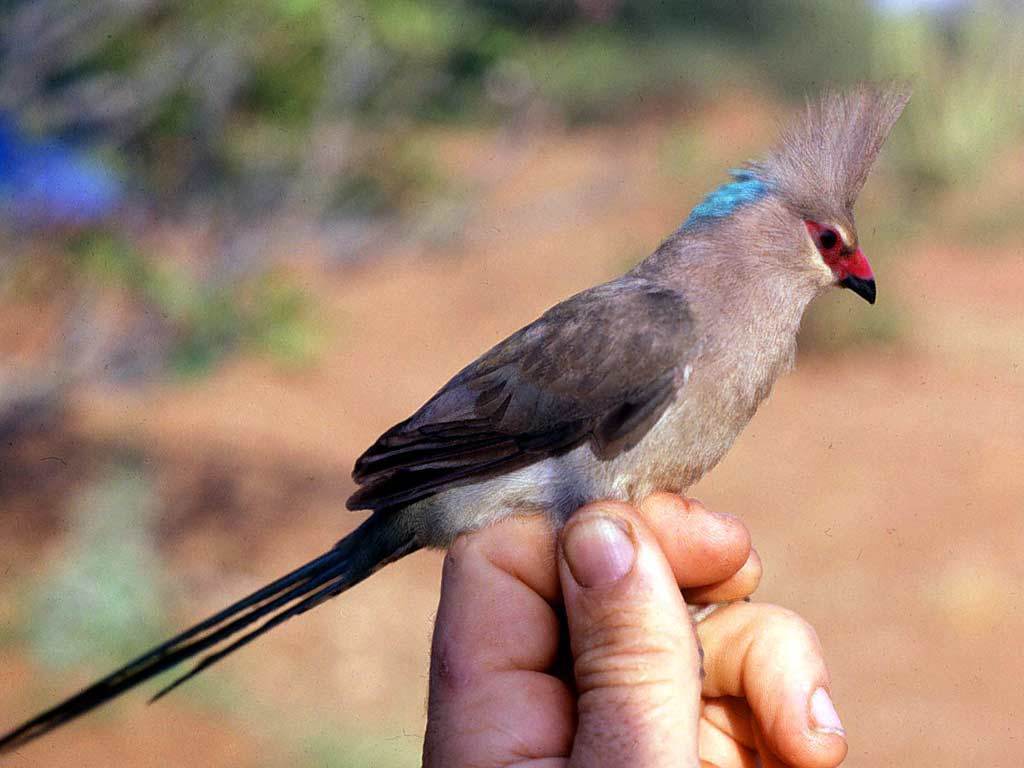
This order consists of the single family of coly or mouse birds (family Coliidae). All six (6) species are African and are small birds with very long, stiff tails and prominent crests. Dull in colour, they have crests and short, thick, pointed beaks. Unlike other birds, they can direct all four toes forward or move the two outer toes backward.
- KEY POINTS SUMMARY
Mouse birds are found only in SUB - SAHARAN AFRICA, they are gray or brown, and move in a rodent like, scuttling way when feeding. They have conspicuous crests, well – developed legs, and feet with an outer toe that can swivel to point backward or forward. Instead of perching, they often hang vertically or upside down from a branch. Mouse birds feed mainly on buds, fruit, and seeds. However, rarely they eat insects, and even the young of other birds. They typically live in flocks of up to 30, which break up at the beginning of the breeding season and reform when the nestlings are fully fledged. They young clamber out of the nest when a few days old, returning to it at night. Peculiar, long - tailed birds that creep mouse – like in bushes and trees. Flight fast and direct. Occur in small groups, roosting together and often sunning themselves. Sexes a like.
- SPECKLED MOUSE BIRD (Colius striatus)
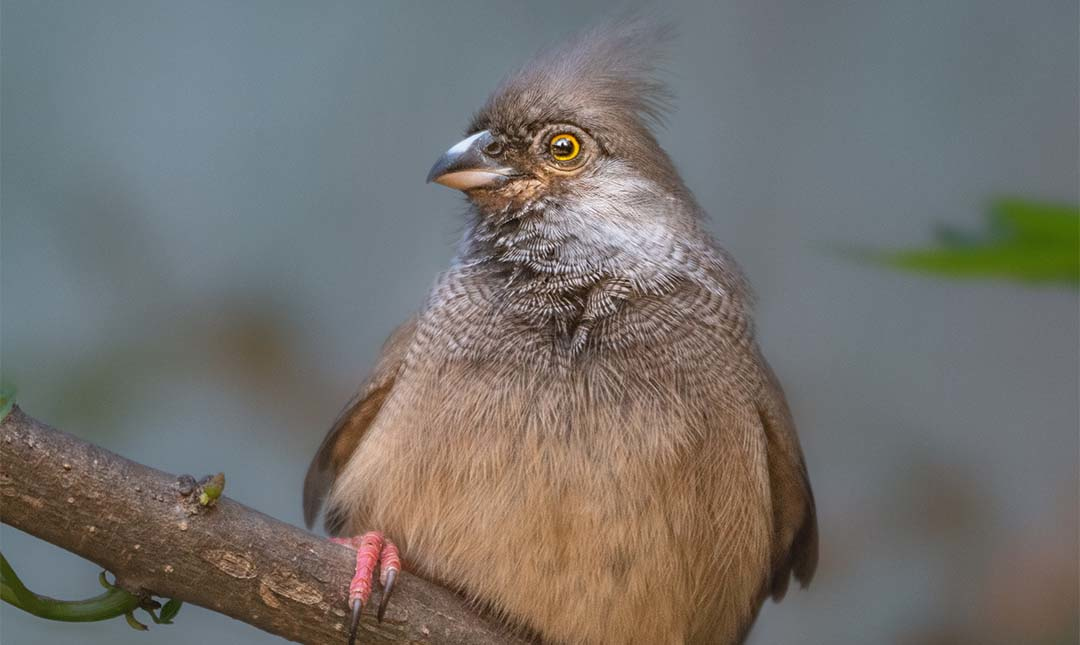 A crested, very long – tailed, brown bird. Face blackish, with silvery cheek in some races (subspecies); bill often black above, silver below. Some races (subspecies) have fine dark barring on chest. Cinnamon under wings. Legs red or dark puple. L. 14’’ (35cm).
- Similar Species; Larger, darker and browner than other mouse birds, with no red or blue on head.
- Voice; A harsh tsik – tsik when alarmed, and a warbling tsu – tsu in flight. ·Habitat (Ecology); Edges of forests, woodlands, scrub, plantations, gardens, and towns.
- Nesting; builds a shallow nest of sticks, grass, leaves, paper and cloth in a low thick bush. Usually lays 3 eggs. Parents and helpers feed young.
- Range (Distribution); Cameroon east to Eritrea, thence south through e Africa to Cape Province. Ranges to 9,200” (2,800 m).
- Status; Common; usually in groups, often sunning after feeding or dashing between bushes in “follow – my – leader” fashion.
- NOTE AND REMEMBER;
This is a common and successful species. When traveling, flock members fly across open areas one at a time, their long tails trailing. The speckled mouse bird feeds on fruit, buds, and leaves, and may be a nuisance in gardens and orchards. Clusters of up to 20 roost side by side for warmth.
- KEY POINTS SUMMARY (SPECKLED MOUSE BIRDS)
The most studied, the speckled mouse bird, may have a breeding group made up of one to three male helpers, which are usually related, and one to three non - related female helpers. The helpers are usually young birds. Of interest is that the dominant male takes a single mate but other males maybe polygamous. In the case of this, and possibly other species the flock’s territory is guarded year – round.
- BLUE – NAPED MOUSE BIRD (Urocolius macrourus)
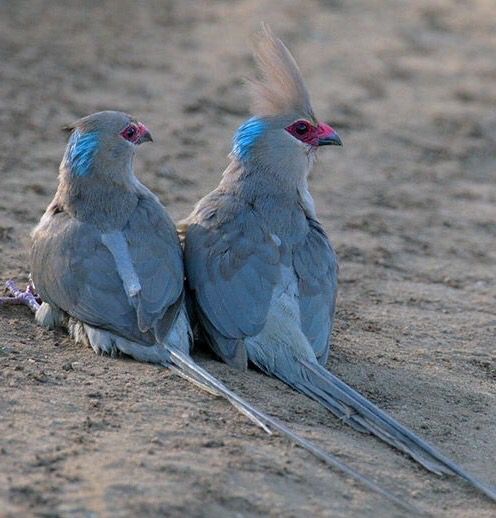 Pale gray (including crest), with long, thin, slightly bluish tail. Bright red at base of bill and around eye; turquoise – blue on nape. L .14’’ (35cm).
- Similar Species; Red - faced Mouse bird (Urocolius indicus) lives in dry woodlands from sw Tanzania to Cape Town area; pale gray with buffy head; has large patch of bare red skin on face.
- Voice; A clear peeu – peeu, given often at rest and in flight.
- Habitat (Ecology); Open arid country with thorny trees, watercourses, palm groves, and vicinity of wells and villages.
- Nesting; Lays 2 or 3 eggs in an untidy cup nest of twigs, grass, and rootlets, placed in a tree or thorny bush.
- Range (Distribution); Mauritania and Guinea – Bissau east across Sahel to Djibouti, and south to s Tanzania.
- Status;locally common; in flocks of up to 50 birds.
- KEY POINTS SUMMARY (BLUE – NAPED MOUSE BIRD)
The only mouse bird in Western Africa, the Blue – naped feeds on fruit, berries, leaves and flowers. This bird flies in flocks; up to 50 birds may gather in one fruiting tree.
- RED - BACKED MOUSE BIRD (Colius castanotus)
Endemic to Angola. Forms a superspecies with Speckled Mouse bird, and their range overlap marginally in N; differs in having reddish (not brown) back, brown (not whitish) ear coverts and crest, and pale (not brown) eyes. Co - occurs with Red – faced Mouse birds, but is much darker brown (not pale grey), and lacks red face patch; flight is weaker. Habitat (Ecology); Riverine woodland, forest edge, Euphorbia scrub, farmlands and gardens. Status; Common. Voice; Whistled “zweet” similar to White – backed Mousebird’s and harsher zhrrik”. · Range (Distribution); Angola.
- WHITE – BACKED MOUSE BIRD (Colius colius)
Endemic to S Africa. Paler and greyer than Speckled Mouse bird, with mostly white bill and coral - pink legs. In flight, central back is white, bordered by glossy violet stripes (appear black in the field). Paler and shorter – tailed than Red – faced Mouse bird, with weaker flight. Habitat (Ecology); Strandveld, fynbos and scrubby areas in semi – desert. Status; Common; usually in flocks of 3 – 10. Voice; Rather harsh, whistled “zwee – wewit” · Range (Distribution); South Africa, Angola, Namibia, Botswana.
- WHITE – HEADED MOUSE BIRD (Colius leucocephalus)
Endemic to NE Africa. Whitish crest (extending forward to base of bill) and black – and - white vermiculated neck, upper breast and back are diagnostic. Paler and greyer than speckled Mouse bird, with mostly white head (including face) and bill; does not overlap with White – crested races of Speckled Mouse bird. Dark grey orbital skin appears as blackish mark. Whitish stripe down back is usually visible only in flight. Juvenile has buffy throat and upper breast.
- Habitat (Ecology); Dense bush and creepers in arid habitat up to 1300m. Status; Uncommon to locally common. Voice;Contact call is scratchy “ tsik tsik; song is descending “tsip-tsip tseeeer”. · Range (Distribution); Northern Tanzania, Kenya, Somalia.
- RED - FACED MOUSE BIRD (Urocolius indicus)
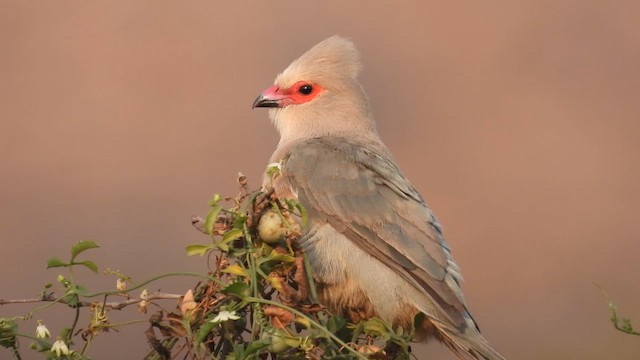 A pale grey mouse bird with a bare red face. Red face and generally paler appearance separate it from Speckled and White - backed mouse birds. Lacks blue nape patch of Blue – naped Mouse bird. In flight, grey rump contrasts with darker back and tail. Flight is direct, fast and powerful; usually more sustained than Colius Mouse birds. Juvenile has yellowish – green face. Habitat (Ecology); Thornveld, open broadleafed woodland and suburban gardens. Status; Common resident. Voice; Clear, whistled “chi vu vu’, first note higher pitched. · Range (Distribution); Southern Africa (South Africa, Namibia, Botswana, Angola, Zambia, Zimbabwe, Mozambique, Malawi, Lesotho, Etiswatini
- One Family (Musophagidae)
- Genera; 5 genera
- Species; 22 species in 5 genera
An endemic African order, with a single family (Family Musophagidae). Large, long-tailed birds that bound adroitly through forest and woodland canopy. Flight quite weak; gliding between trees. Sexes usually alike. Many species quite similar, but ranges often don’t overlap. The name Musophaga means banana / plantain – eater but apparently these birds rarely, if ever, feed on this fruit. In South Africa, these birds are often referred to as LOERIES or LOURIES. The name “go – away bird” is sometimes applied to the savanna – dwelling turacos and is derived from their frequently uttered call, a curse to the hunter intent on stalking prey, because it alerts the game to the presence of danger. This is an exclusively sub – Saharan African family of about 22 species (several of the “green turacos” are sometimes lumped as subspecies (races) of Tauraco persa).
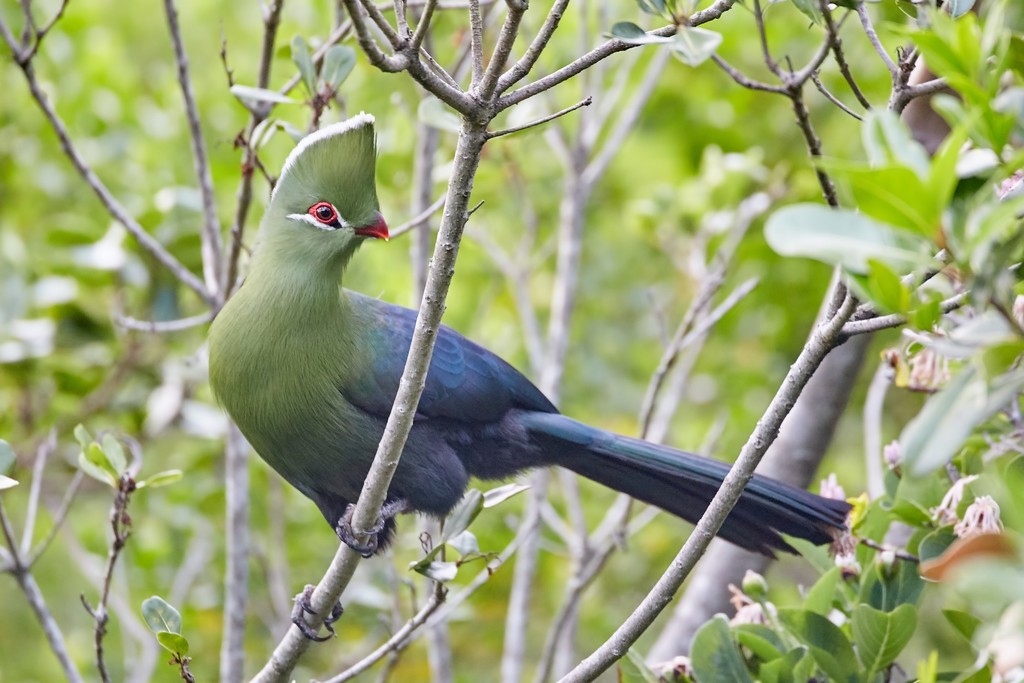
An ancient group of birds, their relationship with other orders is somewhat murky. Turacos are fairly large and the majority are inhabitants of forest and dense woodland. These species have green or blue plumage and red wings. The bright plumage colours of most other birds are produced by the refraction of light from minute structures in the feathers, but turacos have true pigmentation; the red pigment is known as turacin and the green pigment as turacoverdin. All species have crests, in some more developed than in others. The bills are short and stout, the wings are short and rounded, and the tails are long. They have the ability to bend their outer toes backwards or forwards, an aid to their squired – like running along tree branches and through leafy tangles. All are noisy birds; most utter similar croaking calls but the Savanna species utter variations on the “go-away” theme. In the case of the forest dwellers the call is often the only indication of their presence. They seldom show themselves, except for the occasional flash of crimson wings as the bird crosses a glade or clearing. They are poor fliers, normally covering only short distances in weak, dipping flight. The “typical” turacos are those with glossy green or purple – violet plumage and large areas of red on the wing. They are closely restricted to forest and woodland. The greatest diversity of turacos occurs in the tropics. Several have very limited ranges and some are under threat because of habitat destruction. Turacos usually live in pairs or small family parties. Larger numbers of the Savanna species, in particular the grey turaco, sometimes gather near water or a good food source. The bulk of their diet is fruits and berries, but seeds, buds, flowers and a range of invertebrates are also taken. The latter includes snails, beetles and caterpillars. However, few turacos have been studied in the wild and little information exists on behavior, reproduction or diet. The nest is usually a fairly bulky but rather loose platform of sticks constructed in a tree, in which the two, occasionally three, plain eggs are laid. Both parents feed the young with regurgitated food. The young leave the nest long before they can fly, in some cases only 10 days after hatching, crawling along the branches where the adults feed them until they are mature. The largest member of this family is the magnificent great blue turaco, an inhabitant of tropical forests, where it usually spends most of its time in the canopy. They are more gregarious than the other forest turacos and form small parties of up to 18 birds, usually less. Each group has its own territory. Fischer’s turaco is restricted (endemic) to forest pockets near the East African Coast and the Island of Unguja, Zanzibar, where it only occurs in the Jozani Chwaka Bay National Park. It was thought to be extinct there for many years but small numbers still survive. Much more severely restricted and threatened is Bannerman’s turaco, occurring in a very limited area of western Cameroon. Prince Ruspoli’s turaco is a zoological unknown, even though in its very restricted southern Ethiopian range where it occupies juniper forest it is said to be common. Another species occurs in the Ruwenzoris, taking its name from these mountains, and through Kivu to Mount Kabobo, where it occupies the forested and bamboo - covered slopes up to about 3400m. The three (3) go - away birds, one entirely grey and two with grey and white plumage, occupy woodland savannas, particularly those that have many acacia trees. They are stronger fliers than their forest - dwelling relatives and are often more tolerant of human intruders. The two species of grey plantain – eaters are rather nondescript with black, brown and white plumage contrasting with the stout, yellow bill.
- GREAT BLUE TURACO (Corythaeola cristata)
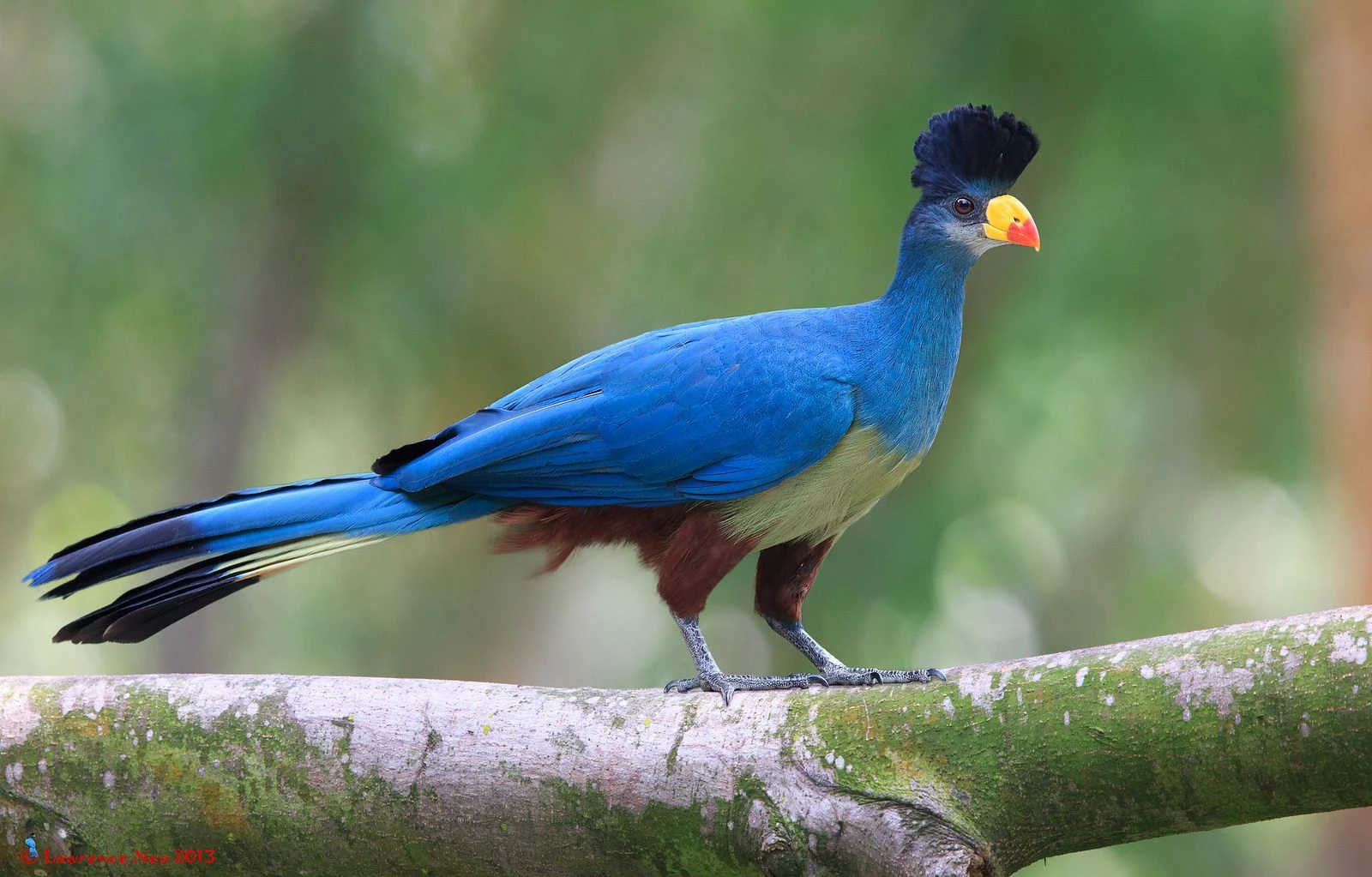 Swollen yellow bill with red tip. Enormous fluffy black crest over entire crown; blue head, neck, back, and wings. Green chest: yellow belly: Chestnut vent. Blue tail green on sides and yellow below, with broad black terminal band. L. 30” (75 cm). Voice; A deep gobble, followed by up to 50 Kok notes running for about 10 seconds. · Habitat (Ecology); Lowland and montane forests, riverine forests, tall trees left standing in felled forests and old tree plantations.
Nesting; Courtship involves calling noisily, flying about, and flapping wings while perched. Lays 2 eggs in a platform nest, usually built in a clump of leaves on a branch over water.
Range (Distribution); Guinea east through Congo Basin to w Uganda also sw Kenya.
Status; Locally common. Usually in flocks of 5 - 8 birds.
- Key Points Summary (The Great Blue Turaco);
The Great Blue is the largest turaco, and a most thrilling sight to see. A poor flier, it often glides downward; upon landing, it hops upward. It is usually seen in parties of a half dozen, though several groups may converge on fruiting trees; it feeds on a wide variety of fruits, leaves, buds and flowers.
- WESTERN GRAY PLANTAIN – EATER (Crinifer piscator)
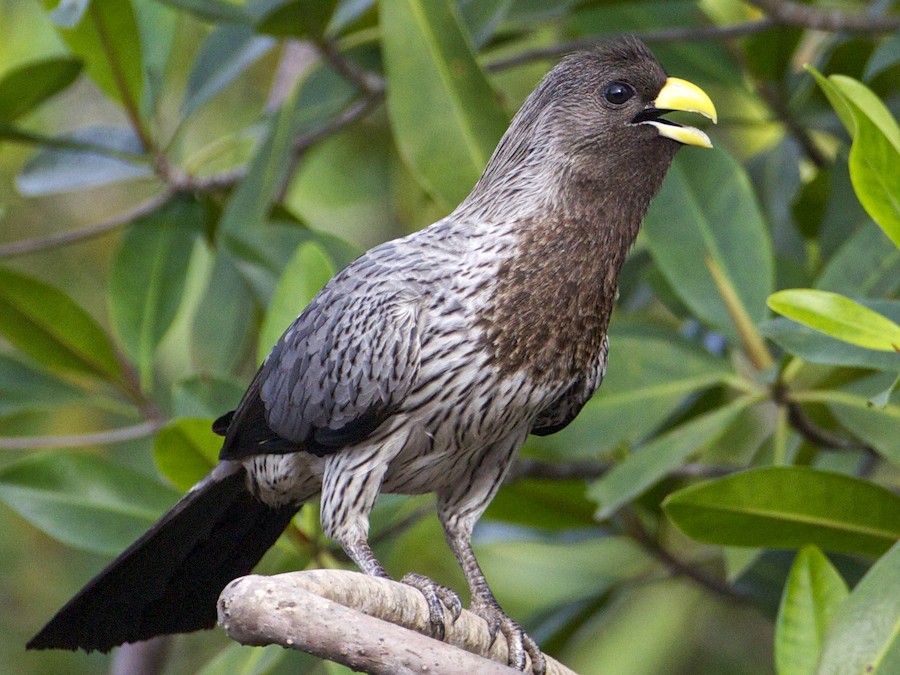 Swollen yellow bill: dark brown head and neck: long spiky feathers on back of head and neck. Underparts white, with heavy black streaks; blue – gray above, with white patch on black primaries; blackish tail. L. 20” (50cm).
- Similar Species; Eastern Gray Plantain – eater (C.zonurus) is browner, with plainer breast, white tips to neck feathers, and white bases to outer tail feathers; common in savannas from Ethiopia south through Uganda, w Kenya, and nw Tanzania to Burundi.
- Voice;Chief call is a series of yelping cow notes.
- Habitat (Ecology); Wooded savannas, acacia woodlands, mango grooves, and rain - forest edges. · Nesting; Courting bird flies up noisily and then tumbles in a dive. Lays 2 or 3 eggs in a stick nest up to 33” (10 m) high in a leafy tree.
- Range (Distribution); West Africa from Senegal east to Central Africa Republic; also s Congo and w DRC. Status; Common.